
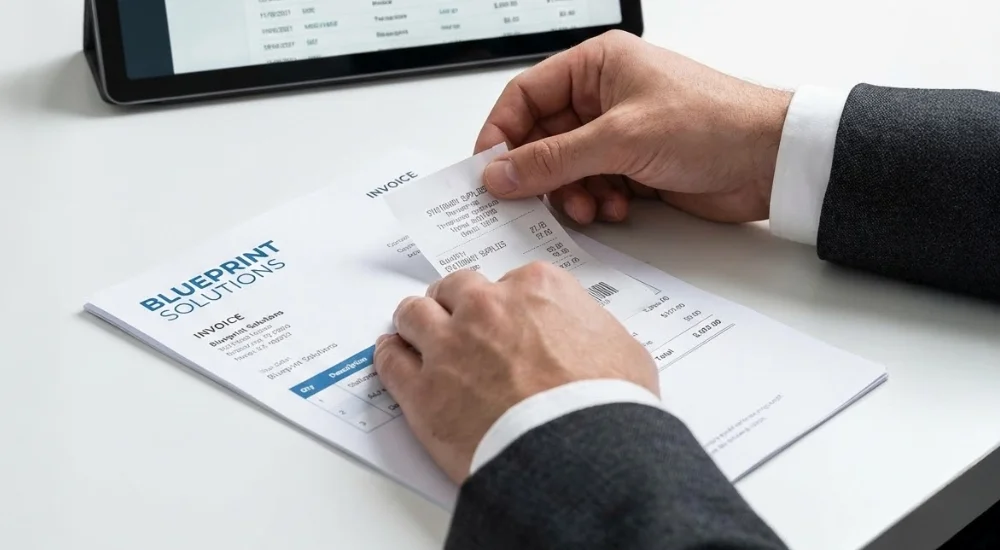
Sales to individuals must always be registered on the cash register first. You issue an invoice only at the customer's request (they have 3 months for this). To avoid paying double tax, you must attach the original receipt to your copy of the invoice and mark it with the "FP" symbol in the JPK_V7 file.
As an entrepreneur, you make dozens of decisions every day. In the rush of daily duties, it is easy to make a mistake when documenting sales – especially when an individual customer suddenly requests an invoice. Fiskasy.pl is your trusted partner, which is why we prepared a straightforward action guide for you. We will walk you through this process step by step so you can be confident that in 2026 your tax office settlements are crystal clear.
Always start with a receipt
You need to know that under Polish law, the basic rule is to record sales to natural persons (and flat-rate farmers) on a cash register. An invoice for such a customer is always a secondary document. It does not replace the receipt – it is merely a supplement to it.
What is more, there is a long list of goods and services for which a cash register is strictly mandatory right from the first transaction, with no exemptions. These include, among others:
Services: hairdressing, beauty, medical, dental, legal, vehicle repair and washing, gastronomy, and passenger transport (taxi).
Goods: LPG gas, auto parts, fuels, cigarettes, alcohol (over 1.2%), perfumes, and toilet waters.
If you sell anything from this list to a private individual, you must register it on the cash register.
The customer requests an invoice. Keep track of these deadlines!
A customer has the full right to request an invoice from you (regardless of whether they paid by cash, card, or bank transfer). They have exactly 3 months to do so, starting from the end of the month in which you sold the goods or performed the service.
How should you react?
If the request is made in the same month as the sale – you should issue the invoice by the 15th day of the following month.
If the request is made later – you must issue the document no later than the 15th day from the date of the request.
Prerequisite: You issue an invoice only if the customer returns the original fiscal receipt to you.
Watch out for the trap: A receipt with NIP is already an invoice
Don't do double work. If the purchase amount does not exceed 450 zł gross (or 100 euro) and the receipt contains the buyer's NIP, this receipt is already a simplified invoice. According to the regulations, until January 1, 2027, it is a fully valid accounting document. In this situation, you are not allowed to issue a separate, standard invoice for it!
The FP procedure: How to avoid paying tax twice?
This is the most important point. If you already have a receipt and issue an invoice for it, you must protect yourself against double counting VAT and revenue. Follow these two steps:
Attach documents: Take the original receipt from the customer and physically attach (or staple) it to your copy of the invoice. This is your proof for the tax office that the sale went through the cash register.
Mark in JPK_V7: In your accounting system, you must add the "FP" tag to this invoice in the JPK_V7 file. Thanks to this, the tax office knows that the tax has already been accounted for via the cash register and will not add it again.
What to include on an invoice for an individual?
When issuing such a document, you apply standard rules, with two important exceptions:
No NIP: Enter the customer's name and address, but leave the NIP field blank (unless it is a flat-rate farmer who specifically requests it).
Receipt number: You must include the number of the receipt to which it relates on the invoice, which makes linking documents easier.
(If you are on a flat-rate tax on recorded revenue – enter only the flat tax rate on the invoice, without the VAT amount).
The exception to all the above rules is the sale of company assets (a fixed asset, e.g., a company laptop) to a private individual. Such a transaction usually does not go through the cash register – you simply issue an invoice directly or sign a purchase-sale agreement.
You can find more information on this topic in the extensive ESC SA article: Faktura dla osoby fizycznej a kasa fiskalna – co warto wiedzieć?
Choose equipment that makes life easier
Don't want to manually track document links and worry about errors in JPK files? Contact the experts at Fiskasy.pl. We will select a modern cash register or fiscal printer for you that automates entering the buyer's NIP and streamlines recording invoices for receipts. Call us and work with peace of mind!