
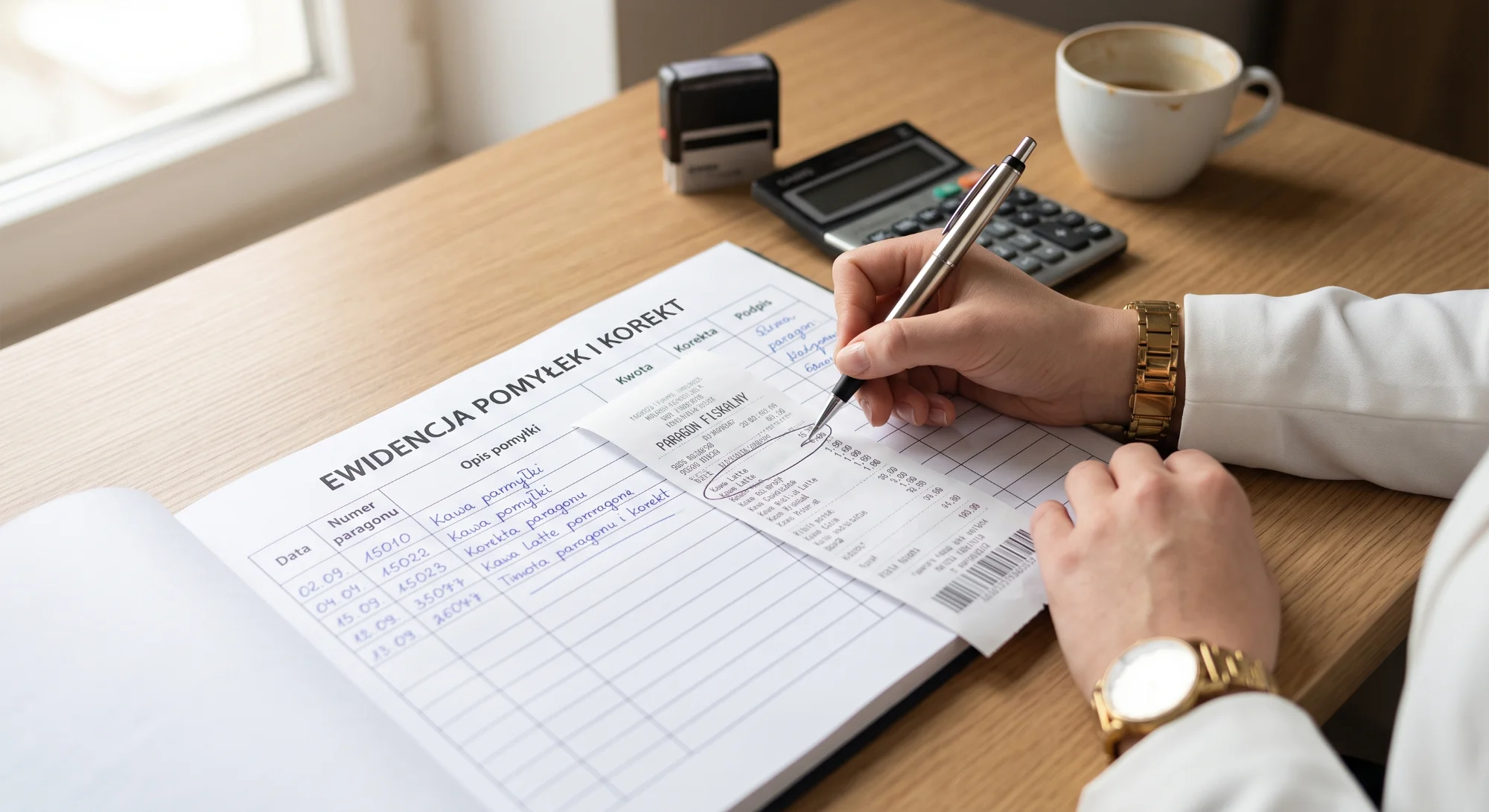
You entered the wrong amount on the cash register or a customer returned an item. As an entrepreneur, you need to know that a fiscal cash register cannot issue a negative receipt. It is your duty to immediately and properly document these events outside the device. Taking the right action is the only way to protect your business from accounting discrepancies, questioned tax settlements, and fines from the tax office.
What You Need to Know About Adjustments and Mistakes
- You must maintain two separate sets of records: records of obvious mistakes and records of returned goods and accepted complaints (adjustments).
- This is required by the regulation of the Minister of Finance of 25 June 2025 on cash registers, specifically § 3, paragraphs 4 and 5.
- Correct an obvious mistake promptly – make sure to retain the incorrect receipt and issue a new, fully correct one.
- Store the compiled documentation for at least 5 years.
- In the JPK_V7 file, adjustments originating from fiscal cash registers receive the RO marking.
When Do You Use the Records of Mistakes on a Fiscal Cash Register?
The record of mistakes is used to correct errors identified "here and now". You use it for obvious mistakes, for example when:
- You add an extra "0" at the end of the price, making a kilogram of flour cost 50 zł instead of 5 zł.
- You select the wrong item from the cash register menu – e.g., entering PLU code 033 (tomato juice) instead of 022 (tomatoes).
Your Step-by-Step Action Plan:
- Keep the incorrect receipt – absolutely do not throw it away, as it serves as proof of the incorrect recording.
- Make an entry in the records – note down the date, time, receipt number, incorrectly recorded gross amount, and VAT.
- Provide the reason – briefly and specifically explain the circumstances, e.g., "mistakenly entered 150 zł instead of 15 zł". If you have multiple devices in your company, specify the registration number of the fiscal cash register where the error occurred.
- Attach the proof – staple or clip the original incorrect receipt (or equivalent proof) together with the recorded entry into a binder.
- Print the correct receipt – record the sale again, this time accurately reflecting the transaction, and issue the sales receipt to the customer.
At the end of the month (or other adopted VAT settlement period), summarize the entries from the record of mistakes. Based on this, you will adjust the total revenue amount resulting from the cash register reports for the given period.
When Do You Use the Records of Sales Adjustments?
You keep this record for events occurring after the sale has concluded: returns of goods, accepted warranty claims, or retroactive price reductions. The entry must be made on an ongoing basis, on the exact same day the refund is issued to the customer.
Practical scenarios:
- Customer returns the goods or part of them – you prepare an adjustment and make an entry in the records.
- Exchange for a cheaper product – you prepare an adjustment and refund the overpayment to the customer.
- Exchange for a more expensive product – you do not make an entry in the returns record; instead, you issue a new receipt solely for the price difference.
What You Must Include in the Adjustment Records:
- Date of sale and date of return or complaint.
- Precise description of the item the sale concerns.
- Gross value of the return and its corresponding VAT (for a partial return, enter the partial amount).
- Receipt number (or the invoice number issued for the receipt).
- Document confirming the payment refund, e.g., payment terminal receipt, bank transfer confirmation, cash receipt/voucher (KP/KW).
- Specific reason for the event – return, complaint, or overpayment resulting from an error.
Remember that you must attach a copy of the receipt or invoice and a return protocol signed by both parties to every such entry.
How to Keep and Store Documentation?
Regulations do not impose an official format for documentation – you can use an ordinary notebook, a binder with loose sheets, or dedicated templates. Keep in mind that modern online cash registers automatically transmit data to the Central Cash Register Repository (CRK) supervised by the National Revenue Administration (KAS), but this does not exempt you from the obligation to maintain additional records of mistakes and returns outside the device.
Safety Guidelines:
- Store the records for a minimum of 5 years, starting from the end of the year in which the tax payment deadline expired.
- Always make scans of receipts. Thermal paper darkens under higher temperatures, so avoid keeping documentation near heat sources, such as a radiator.
Lack of proper records is a direct route to issues with the tax office: you risk VAT reassessments on overstated and erroneous sales, as well as severe fines and penalties under the Fiscal Penal Code (KKS). Treat diligently maintained records as your safety net.
Streamline processes in your company. Contact the Fiskasy.pl team – we will assist you in selecting modern equipment, perform fiscalization (technical activation of the fiscal mode), and support you in the proper registration of your device with the tax office.