
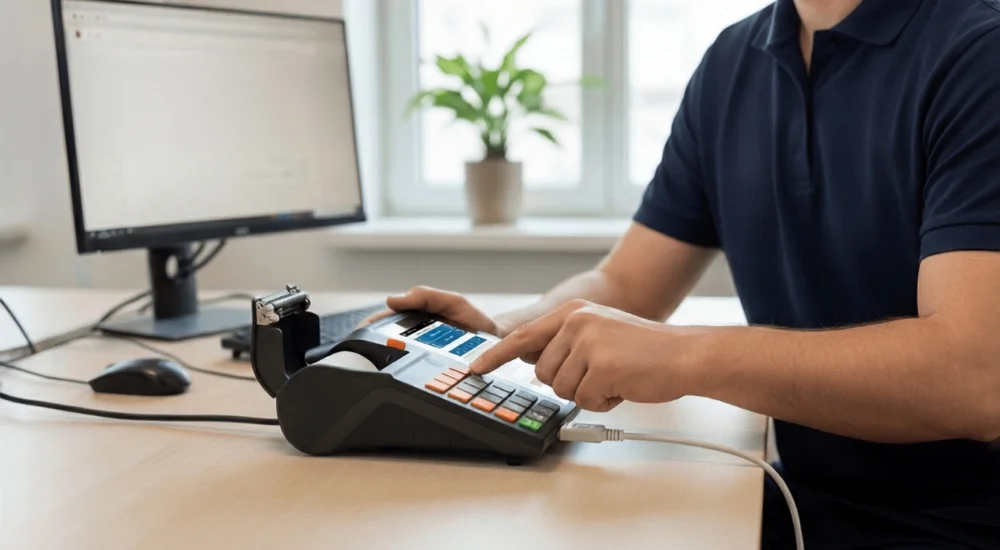
Closing your business, upgrading your equipment, or has the device signaled that its memory is full? You must formally deregister the device from the tax office records. At Fiskasy.pl, we know that decommissioning a cash register involves strict legal procedures where costly oversights can easily happen. Below, we have gathered all the specifics: learn what you need to do step by step, how much it costs, and why you cannot complete this process without an authorized service technician.
Performed by: The fiscal memory readout and closing the cash register in fiscal mode can be performed only by an authorized, certified service technician. You cannot do this on your own.
Cost: The standard service of reading the fiscal memory and preparing the official report usually costs approx. 350 zł net (the final price depends, among other things, on the device model and potential travel costs).
Key deadline: You have exactly 5 calendar days from the date the technician prepares the report to submit the complete application with attachments to the relevant head of the tax office.
Your task before visiting the service center: Before handing over the device, you must print the last daily fiscal report and the last periodic report.
What about documents and equipment: You must retain tax documentation (including the register book and reports) for 5 years (counted from the end of the year in which the tax payment deadline expired). A deregistered device becomes e-waste – you can safely dispose of it for a symbolic fee of 1 zł.
When Are You Legally Required to Perform a Cash Register Readout?
The obligation to carry out this procedure arises directly from Art. 111(7a) and Art. 111(3a)(13) of the Goods and Services Tax Act, as well as the Regulation of the Minister of Finance of June 25, 2025, on cash registers.
You must strictly carry out this procedure in three cases:
Liquidation of business activity – the most common reason for withdrawing a register from use.
Deregistering the device – when you retire a given register, e.g. replacing older equipment with a modern online cash register.
Fiscal memory full – cash register memory has a specific capacity (number of daily reports). Once full, you must close its fiscal mode and replace the module or purchase a new device.
Remember: for traditional cash registers (with paper or electronic copy), a physical module readout is performed, while for online registers, the "termination of operation in fiscal mode" procedure applies. In both cases, the result is identical: the device permanently switches to read-only mode, preventing further sales registration.
Step-by-Step Readout Procedure: From Your Premises to the Tax Office
Step 1: Your Preparation Before Handing Over the Register
Before handing the device over to our team, make sure to take care of two printouts:
Last daily fiscal report – generate it at the close of the final day of recording sales.
Last periodic (monthly) report – an integral part of your records used for data verification.
Step 2: Service Technician Actions and Official Report
You hand over the cash register to the service center. The authorized technician:
Closes the fiscal mode of the device and generates a final settlement fiscal report covering the entire operational period of the register – from the moment of fiscalization to shutdown.
Prepares an official report on the readout of the fiscal memory contents (compliant with the template in Appendix No. 4 to the regulation). The document includes your company details, register identification numbers, turnover and VAT summaries, and signatures of both parties.
Step 3: Submitting Documents to the Tax Office (Watch the Deadline!)
Within up to 5 calendar days from the date the report is drawn up, you must deliver the following to your tax office:
Application for deregistering the cash register from records (according to the template in Appendix No. 5 to the regulation).
Fiscal memory readout protocol (prepared together with the technician).
Settlement fiscal report (summary printout from the register).
Important: The cash register service book must be updated by the technician with an entry confirming the readout, but you do not submit it to the tax office. It stays with you – you are legally required to store it.
How Much Does a Fiscal Cash Register Readout Cost and What Affects the Price?
The average cost of performing a memory readout along with drafting the legally required protocols is approx. 350 zł net.
The final price depends on:
Scope of support – the standard rate covers the technical process itself and drafting the protocol.
Technician travel – performing the service at the service center is cheaper than scheduling an on-site visit at your premises.
Device model – older, non-standard devices may require more time and specialized hardware.
If you want to learn even more technical and legal nuances of this process, you can find more information in the comprehensive article by ESC SA: Fiscal cash register readout – what does it involve and how much does it cost?.
What to Do with Equipment and Documents After Deregistration?
Wrapping things up at the tax office is not the end of your responsibilities. You need to take care of two things:
Archiving documentation for 5 years
You must safely store the settlement report, readout protocol, and the entire cash register book for 5 years, counted from the end of the calendar year in which the tax payment deadline for that year expired. In the event of a tax audit, this is your only proof of proper settlement.Eco-friendly disposal of the device
After fiscal mode is closed, the register loses its legal status – it becomes e-waste (WEEE) and cannot be reused in commercial trade. Instead of keeping redundant equipment on a shelf, you can hand it over for safe, compliant disposal for a symbolic fee of 1 zł (confirmed by an invoice with the serial number or a purchase-sale agreement).
Close Your Cash Register Stress-Free and Error-Free with Fiskasy.pl
The register deregistration procedure requires precision, specialized equipment, and strict adherence to the 5-day deadline. Do not leave it until the last minute.
Contact the Fiskasy.pl team. We will carry out a smooth fiscal memory readout for you, complete all required protocols, and help you prepare a flawless application for your tax office. Call or write to us – we will take care of the rest!